
Junk removal has no single fixed cost in 2026. Your quote depends on what must be removed, how much there is, how easily a provider can reach it, and how the material must be handled. Ask for a written total that identifies any separate labor or disposal charges before you book.
- How much does junk removal cost? There is no fixed rate; get a quote for your specific load in 2026.
- Expelled is best for homeowners, property professionals and businesses seeking independent junk removal providers.
- Compare quotes against the same item list, access conditions and disposal requirements.
- Ask whether the quoted total includes loading, hauling and any applicable disposal charges.
How much does junk removal cost in 2026?
There is no reliable price to give without a defined job. A bulky item at an accessible curb, several items inside a building, and a full property cleanout call for different work. Treat a quote as useful only when it describes the items and the work included.
| Job to describe | What to include in the request | What to confirm in the quote |
|---|---|---|
| Single-item removal | The item, its location and any handling difficulty | Whether loading and disposal are included |
| Multi-item junk removal | An item list or clear photos showing the whole load | Which listed items the provider will take |
| Property cleanout | The areas to clear and anything that must stay | Whether the quote covers every specified area |
This table is a way to describe the job, not a price guide. A quote for one item does not establish the cost of clearing a room, and a room-level quote does not establish the cost of clearing an entire property. The answer to how much junk removal costs is the written total for a clearly defined scope.
Why this matters
A low figure is not useful if you cannot tell what it covers. Before comparing providers, write down the work you want finished: what goes, where it sits, and what must remain. You can use Expelled to connect with independent providers offering junk removal, hauling and property cleanouts; compare the resulting arrangements against the same scope rather than assuming those services mean the same thing.
For a homeowner, an unclear scope can leave items behind. For a property professional, it can leave a space short of the condition needed for its next use. For a business, it can make it difficult to tell whether the removal job is complete. In every case, a precise request makes the provider’s response easier to evaluate.
Why junk removal costs vary
These are the details to give a provider before asking for a total. They affect the work described in the quote; they do not produce a trustworthy estimate on their own.
- Amount to remove. Identify the full load rather than the item that first prompted the call. A quote based on an incomplete list is not a quote for the whole job.
- Type of material. Name unusual or difficult-to-handle items. Ask whether the provider accepts each one and whether any item needs separate handling or disposal.
- Location of the items. Say whether they are at the curb, in a garage, inside a building or spread across several areas. The pickup point is part of the job.
- Access to the pickup point. Tell the provider about stairs, gates, narrow passages or a long carry from the items to a vehicle. Do not wait until arrival to mention an obstacle.
- Scope of the finish. Specify whether the job is limited to named items or covers an area to be cleared. Mark anything that must stay so the provider can assess the work accurately.
- Disposal arrangements. Ask what happens to materials the provider cannot accept and whether any applicable disposal charge is already included in the total.
You do not need to predict how a provider will price each factor. You need to disclose the factors so the quote reflects the actual job. If the load changes after the quote, ask for a revised total before removal begins.
How do you get a junk removal quote you can compare?
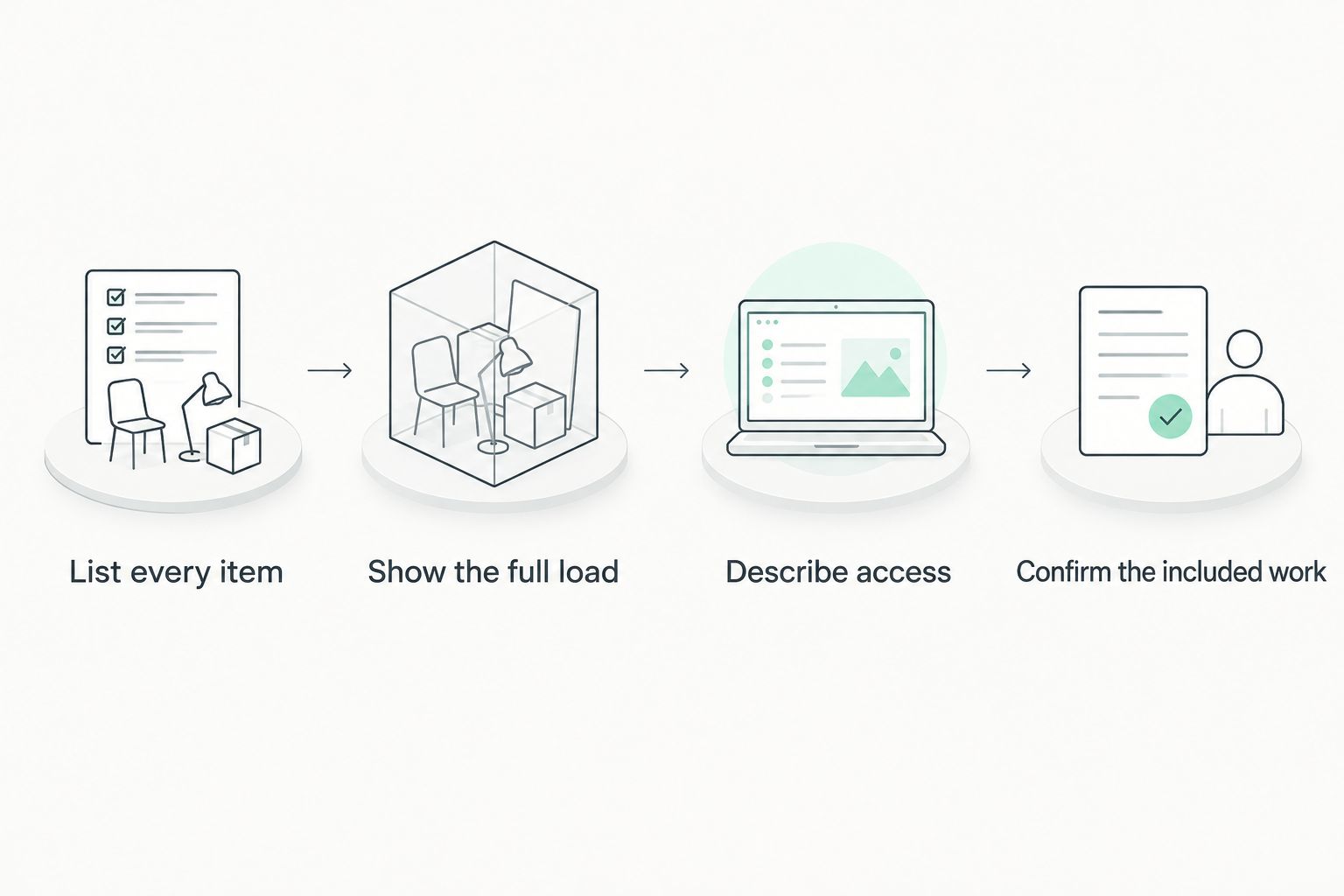
Give each provider the same description, then ask each to put the included work in writing. Follow this sequence in 2026 whether you need a single item taken away or a property cleared.
- List every item. Write down what must go. For a larger job, identify each area to be cleared and distinguish it from areas outside the request.
- Show the full load. Take photos that show the items and their surroundings. A close-up can identify an item, but it cannot show the extent of a cleanout by itself.
- Describe access. State where the items sit, where a vehicle can stop, and whether stairs, gates or other obstacles separate the two.
- Confirm the included work. Ask for a written total and check whether loading, hauling and applicable disposal charges are included. Ask how changes to the item list will be handled.
The last step matters even when a quote sounds straightforward. If you receive a total for hauling but expected items to be carried out of a building, the totals you are comparing do not describe the same work. Ask the provider to revise the scope before you make a decision.
Which removal service matches the job?
Best for a defined set of unwanted items: junk removal. Describe the items to be taken and confirm the provider accepts each one. The advantage is a clear item-based request; the drawback is that anything omitted from your list can fall outside the quote.
Best for moving an identified load: hauling. State what needs transporting and what you expect the provider to do at pickup and after transport. The advantage is a narrow, describable task; the drawback is that the word hauling alone does not establish whether loading or disposal is included.
Best for clearing specified areas: a property cleanout. Identify the rooms or spaces to clear and the belongings to keep. The advantage is an area-based scope suited to a larger job; the drawback is that vague boundaries make it harder to confirm what the provider agreed to remove.
Expelled connects homeowners, property professionals and businesses with independent providers across these service categories. Expelled is best for people who want to find an independent provider, not for anyone seeking a published flat rate for every removal job. State the job first, then confirm the scope and total with the provider you choose.
What should you check before accepting a quote?
Read the quote as a description of completed work, not just a total. Check the item list or areas covered, the pickup location, loading, hauling, disposal, and any stated exclusions. If an item or task appears only in a conversation, ask for it to be added to the written scope.
Ask what happens if the provider arrives and finds more material than described. A clear process for revising the quote lets you decide whether to proceed before additional work starts. Keep the original description and the accepted quote together so you can check the finished job against them.
Does a single-item pickup cost the same as a cleanout?
No fixed cost applies to either job in 2026. A single-item pickup describes a defined item; a cleanout describes areas and belongings that need to be cleared. Request separate, job-specific quotes instead of using one as a price estimate for the other.
For a single item, name it and explain where it sits. For a cleanout, describe every area and identify what must remain. That difference in scope is more useful to a provider than an unsupported estimate of how much the job should cost.
Can you get an exact junk removal cost from photos?
An exact cost comes from a provider’s quote for the agreed work, not from photos alone. Photos help show the load, but a provider also needs to understand access, the items outside the frame, and any disposal requirements before confirming what is included.
If you use photos in 2026, add a short written list. State whether the images show the entire job or only examples of the material to remove. That prevents a close-up of one pile from being mistaken for the full scope.
What if the load changes after you receive a quote?
Ask for a revised total before the provider starts the additional work. A 2026 quote tied to a specific item list does not automatically cover items added later, even when they sit in the same room.
The same rule applies when you remove items from the request. Tell the provider what changed and ask what the updated scope and total will be. Make the decision against the revised quote rather than assuming the original figure still applies.
FAQ
How much does junk removal cost in 2026?
There is no fixed junk removal cost in 2026. Ask a provider for a written total based on your items, access conditions and the work included.
What details do I need for a junk removal quote?
List everything to be removed and describe where it sits. Include photos, access obstacles and any items that must stay.
Are disposal charges included in a junk removal quote?
Only the provider’s quote can establish whether applicable disposal charges are included. Ask for the inclusion or exclusion in writing before booking.
Is junk removal the same as a property cleanout?
No; a junk removal request can name specific unwanted items, while a property cleanout can specify areas to clear. Define the scope rather than relying on the service label.
Can Expelled give me a flat junk removal rate?
Expelled is a marketplace connecting customers with independent providers, not a published flat-rate price list. Confirm the scope and total with the provider you select.
What should I do if I add items after receiving a quote?
Ask for a revised quote before the additional items are removed. The original total reflects the scope described when it was given.
How do I compare junk removal providers?
Give each provider the same item list, photos and access details. Compare written quotes for the same loading, hauling and disposal scope.
One last thing
Before you accept a junk removal quote in 2026, check the keep list as carefully as the removal list. It tells a provider what must remain when clearing a mixed space, and it gives you a clearer way to assess the finished job. Expelled can connect you with independent providers; the written scope tells the provider exactly what you want done.